
Many Salesforce projects start to wobble before the work begins, because the way the work is bought doesn’t match the work itself. A three-month developer need turns into a twelve-month contract. A vague, still-evolving problem gets squeezed into a fixed price. Choosing between Salesforce engagement models is the first real decision, and it comes before you choose a person or a firm.
Start with the shape of the work, not the budget line
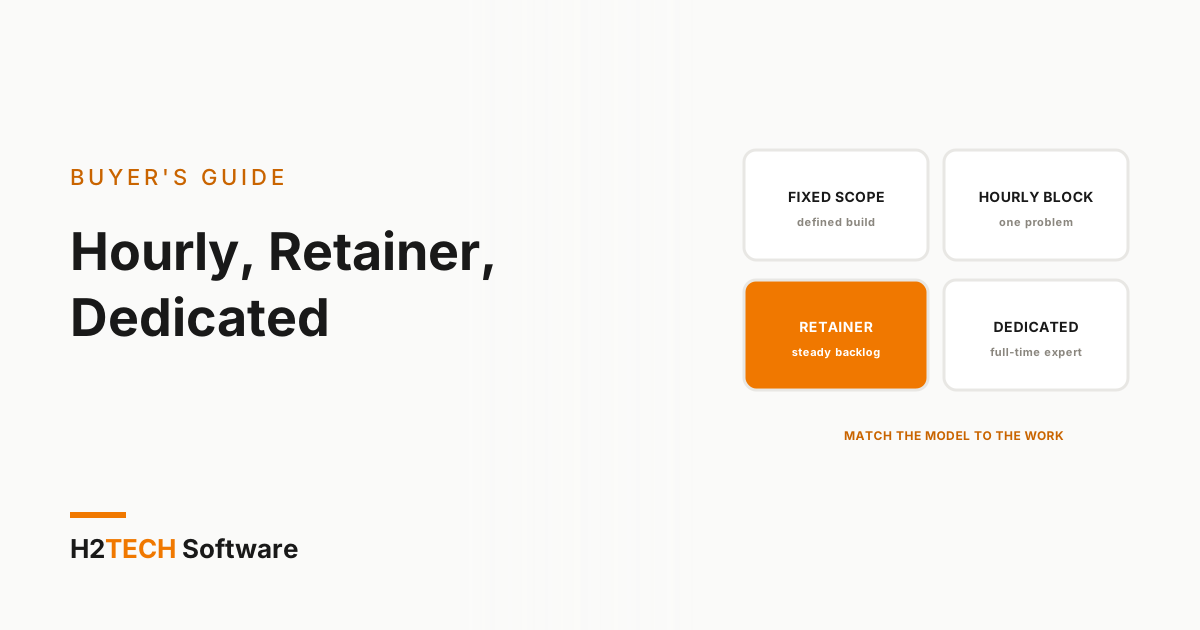
Three questions narrow the field quickly. How clearly can you describe the finish line? How long will the need last? And who will direct the work day to day, you or the partner? A crisp finish line points towards fixed scope. A short, specific problem points towards a block of hours. Steady, uneven demand suits a retainer, and a sustained need that your own team will steer suits a dedicated expert.
Fixed scope: when the finish line is clear
Fixed scope fits a defined implementation, migration or build where the requirements can be written down and the architecture signed off before development starts. You get a firm price and a known outcome, which makes it easy to approve internally. The trade-off is flexibility: if requirements keep moving, every change becomes a negotiation, and exploratory work rarely survives a fixed price.
It works best when the groundwork is done. A well-planned org cutover is a good example: the sequence, the data rules and the rollback plan are known in advance, so the price can be too. Our Salesforce implementation work runs this way: we give a firm price after a free 30-minute review of your requirements, and the project begins once the architecture is signed off.
Hourly blocks: for one bounded problem
A flow that misfires, an integration that drops records, an architecture opinion before you commit to a design: these are problems of days, not months. An hourly block buys focused time on exactly that. It’s the lowest-commitment way to get senior eyes on an issue.
The risk is vagueness. If nobody can say what “solved” looks like, the hours drain away. Write the question down first, agree what a good answer looks like, and cap the block. If the diagnosis uncovers a bigger job, you can switch models with the evidence in hand.
Monthly retainer: for steady improvement
Most live orgs have a backlog that never quite ends: new reports, small flows, user requests, the odd data clean-up. That doesn’t justify a full-time hire, but it’s too constant for one-off blocks. A monthly retainer gives you a set number of dedicated hours, and the same people learn your org as they go, so each month starts faster than the last.
Retainers fail when nobody owns the priorities. Name one person on your side who sets the order of work each month, otherwise hours get spent on whatever is loudest.
Dedicated resource: when you need a full-time teammate
Some work needs capacity, not an answer: a sustained build, a team that has lost its admin, or a fast-scaling sales operation that needs senior architecture without a permanent hire. A dedicated expert works full time as an embedded part of your team, and takes day-to-day direction from you.
One of our own engagements shows the pattern. A growing SaaS company needed senior architecture for a fast-scaling sales team but wasn’t ready to hire full time, so we embedded a dedicated architect on a flexible monthly retainer, starting within five days. The hard parts are direction and continuity. A dedicated expert is only as productive as the clarity of the work you hand over, so agree goals and a handover plan on day one.
A quick way to choose
- Written requirements and a clear end date: fixed scope.
- One bounded problem or decision: an hourly block.
- Ongoing improvement with uneven demand: a monthly retainer.
- Sustained, full-time capacity under your direction: a dedicated expert.
Real projects often mix these. A small, focused engagement is also a sensible way to test a partner before a large commitment, the same logic as the paid discovery we describe in our guide to choosing an implementation partner. Many of our larger implementation and CPQ projects begin exactly this way, once the scope of the bigger need becomes clear.
Terms worth checking whichever you choose
The model sets the shape, but the terms decide whether it’s a good deal. Ask about minimum contract length, how quickly work can start, who exactly will do it and which certifications they hold, and how work is reviewed before it reaches production. Ask who pays for AI and compute costs behind the scenes, too. We explain our position in we burn the tokens, you buy the outcome. Finally, ask what stopping looks like: if the work changes or ends, you should be able to scale down without a penalty.
How H2TECH helps
Our Experts On Demand service covers the three flexible models: hourly blocks for targeted tasks, monthly retainers for ongoing dedicated hours, and dedicated resources who work full time inside your team. There’s no minimum contract, and engagements typically start within five business days of agreeing scope. Tell us the role you need, whether that’s an administrator, developer, architect, CPQ consultant or AI specialist, and we’ll quote within one business day. If you’re unsure which model fits, the free review is the place to work it out.
Key takeaways
- Choose the engagement model from the shape of the work: how clear the finish line is, how long the need lasts and who directs the work.
- Fixed scope suits defined builds, hourly blocks suit bounded problems, retainers suit steady improvement and dedicated experts suit sustained capacity.
- Whatever you pick, check minimum terms, start time, named people, review of output and how you can scale down.